
By Eddie Mugulusi | The Money Engineer
The Hidden Threat Every Honest Entrepreneur Faces
Let’s start with something uncomfortable:
You can run an honest small business, deliver on every promise, treat customers with respect… and still lose business because of someone else’s dishonesty.
It’s unfair.
It’s frustrating.
But it’s the reality of entrepreneurship nobody talks about on Instagram.
This unseen force quietly affects customer trust, your conversion rate, and ultimately your bottom line.
It’s messy, but it’s real.
Let’s break it down.
When One Man’s Mess Becomes Everyone’s Problem
A friend recently planned a long-awaited family holiday to Dubai.
He saved, budgeted, and sacrificed — the way most hardworking people do.
He finally found a Ugandan travel agent based in Dubai.
Not a personal friend. Just an acquaintance running what looked like a promising small business.
They spoke.
They planned.
He paid.
Thirty million shillings — gone.
When the travel date arrived, the agent suddenly became evasive.
Confused stories.
Broken sentences.
No tickets.
No refund.
Just stress, dodging, and police involvement.
And here’s the part that matters:
Stories like this don’t die quietly.
They travel.
They spread.
They stick.
Soon, hundreds of people had heard about it — including potential customers who were already warming up to the idea of using a similar service.
And just like that:
- Every travel agent becomes suspicious.
- Every online vendor becomes “another scammer.”
- Every preorder becomes “too risky.”
- Every small business without a big office becomes “dangerous.”
One dishonest man contaminated an entire category.
That is the Collateral Damage Effect.
What Is the Collateral Damage Effect?
It’s simple:
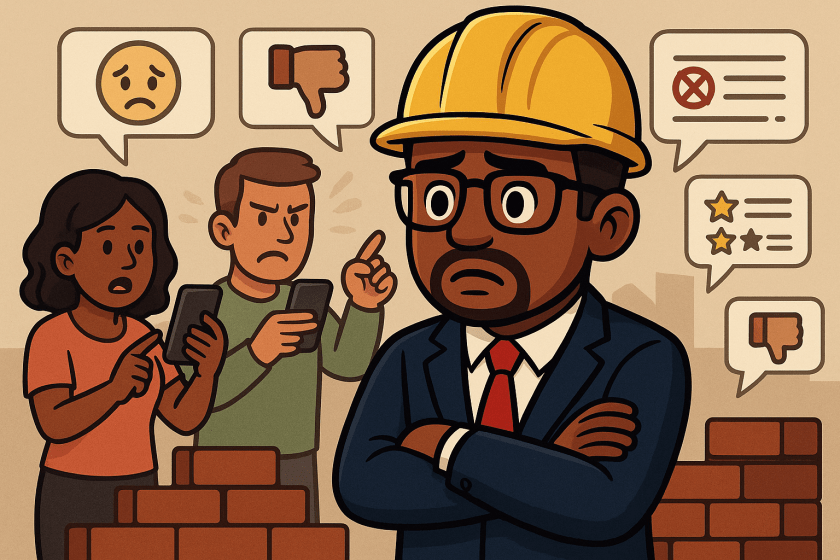
Customers don’t evaluate your business individually — they evaluate you as part of a group.
If one contractor scams someone…
all contractors become questionable.
If one online seller steals money…
all online sellers become “thieves.”
If one safari company disappears with deposits…
all safari companies suddenly look unsafe.
You could be the most upright business owner in the market —
yet you inherit suspicion you didn’t earn.
This is the Collateral Damage Effect:
- A silent tax
- A reputational penalty
- A debt created by someone else — but handed to you
And yes, you will feel it.
The Silent Shift in Customer Behaviour
When dishonesty poisons the market, customers don’t just lose trust — they change how they behave.
You’ve probably seen it:
- The long pauses before they commit
- The hundreds of small questions
- The request for references
- The need to speak to “someone who has used your service”
- The delayed payments
- The nervousness before sending money
They’re not doubting you specifically.
They’re doubting the entire ecosystem you operate in.
They’re simply trying to avoid becoming the next WhatsApp warning.
If you fail to manage this shift, you’ll lose customers —
not because you lack integrity, but because someone else did.
How Smart Small Businesses Fight Back
Here’s the truth:
You cannot control dishonest business owners.
You cannot stop scammers from messing up the market.
You cannot prevent negative stories from spreading.
But you can do something powerful:
You can intentionally and aggressively build trust.
Most small businesses fail here.
They think:
- “I’m honest — that should be enough.”
- “My work will speak for itself.”
- “My product is proof.”
Unfortunately, integrity doesn’t speak loudly in a contaminated market.
You must over-communicate reliability.
Practical trust-building strategies:
If you sell online:
- Offer pay-on-delivery
- Provide clear refund guidelines
- Use real-time tracking or proof-of-shipment photos
If you run safaris or work abroad:
- Create a Ugandan point of contact
- Provide verifiable documents
- Offer video confirmations
If you offer services:
- Use detailed agreements
- Show before-and-after proof
- Provide references proactively
If you handle high-value transactions:
- Show receipts
- Give invoice numbers
- Provide transparent timelines
This isn’t about proving you’re trustworthy.
It’s about reassuring a traumatized market.
Turning Suspicion Into Your Competitive Advantage
Here’s the beautiful twist:
In a marketplace polluted with distrust,
the few businesses that intentionally build transparency and reliability…
win disproportionately.
Why?
Because customers are not looking for the “best.”
They’re looking for the safest.
When your business becomes the one that feels:
- Honest
- Predictable
- Clear
- Professional
- Transparent
…customers will choose you — even if you charge more.
In such a market:
- Trust becomes your product
- Reliability becomes your marketing
- Transparency becomes your sales strategy
And suddenly, the Collateral Damage Effect becomes your advantage.
While others destroy trust,
you become the business people run to.
Conclusion: Be the Trusted Option in a Distrustful Market
Dishonest business owners exist.
Their mess spreads.
Their actions poison the very market you’re selling in.
You can’t stop it —
but you can outsmart it.
Acknowledge the distrust.
Accept that it affects you.
Rebuild your business systems around clarity, trust, and reassurance.
The Collateral Damage Effect harms everyone —
but it also creates rare opportunities for businesses that differentiate themselves through consistency and integrity.
Be that business.
The market is watching.
And trust is the most valuable currency you will ever earn.
 Unlock your true potential